By Miranda Niemas, Nursing Student (BSN candidate)
This guide is currently pending review by a licensed registered nurse.
Last updated: October 13, 2026
Documenting the Therapeutic Milieu on a Psych Unit
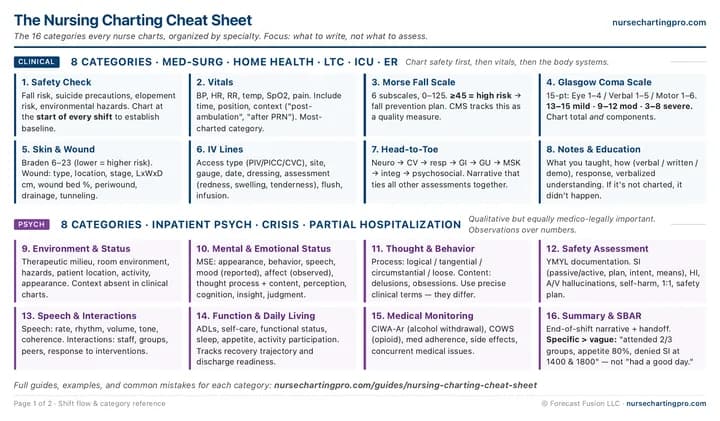
Get the free Nursing Charting Cheat Sheet
- All 16 charting categories, clinical and psych, with what to write for each
- Morse, Braden, Glasgow Coma Scale and SBAR at a glance
- The charting mistakes that cost nurses their licenses
Your psych clinical instructor asked you to document the milieu, leaving you confused about its meaning. I stared at the charting screen for five minutes, trying to understand what "therapeutic milieu" was and how to write it down. No one explained it in lecture; they simply instructed us to "document the milieu" as if it were obvious. It is not. This page clarifies what the milieu is, what you should observe, and how to present milieu entries effectively.
Why This Matters
Regulatory bodies: Joint Commission Behavioral Health Standards, Centers for Medicare & Medicaid Services (CMS)
- Behavioral Health Care Accreditation — The Joint Commission (2025)
- Defining the therapeutic processes in psychiatric milieus — Psychiatry. 1978;41(4):327-335 (1978)
The Awake/Asleep Gate
What Therapeutic Milieu Means
How to Document the Milieu
Patient On/Off Unit Status
Common Mistakes
"Milieu: therapeutic" with no supporting detail
"Therapeutic" is a conclusion, not an observation. It tells the next nurse nothing about what the patient actually did or where they were. Milieu documentation should read like a timeline of specific observations that let the reader draw their own conclusions about the patient's engagement.
Documenting Milieu Observations for a Sleeping Patient
A sleeping patient cannot be "in the milieu" or "engaged in activities." When the patient is asleep, document what you can observe: position, breathing, room safety, and any sleep-related findings. The awake/asleep gate exists precisely to prevent this kind of contradictory documentation.
Documenting unit-level events that affected the patient
A unit event, such as a code, escalation, or visitor disruption, influences the milieu. If it affects your patient's behavior or engagement, document the event and the patient's response. Without this context, the note "patient isolative" appears as an unexplained change. With the context, it becomes an understandable reaction to a stressful unit event.
Conflating On-Unit Location with Bed Location
'In bed' describes a position, not a location status. Clinically, it is essential to identify whether the patient is in the milieu (common areas), in their room, off the unit, or isolating. Within those locations, you can add positional detail, but the location category comes first.
Case Example
Scenario
Mr. Romero is a 38 year old male admitted 3 days ago with MDD and passive SI. He has gradually engaged more with the milieu during his admission - initially isolative on day 1, attending one group on day 2, and today is your day shift (0700-1900). You document his environment and status at regular intervals throughout the shift. This example illustrates the rhythm of milieu documentation across a full 12-hour shift.
Chart Entry
0800 - Awake. Patient up and dressed in street clothes; grooming improved from yesterday (showered, hair combed). In dayroom for breakfast, sat alone at a table near the window. Ate approximately 75% of meal. No interaction with peers during breakfast. Staff approached to check in - patient made brief eye contact and stated, "I am okay, just tired." Mood appears low but less withdrawn than yesterday.

0930 - Awake. Patient attended community meeting in the group room. Sat in the back row near the door. Did not volunteer any comments but nodded when the group leader asked if he had any weekend plans. Remained for the full 30-minute session.

1100 - Awake. Patient in dayroom, sitting on the couch watching TV with one peer. Observed a brief verbal exchange with the peer about the program on television. This marks the first spontaneous peer interaction documented this admission. Patient appeared comfortable - relaxed posture, occasional eye contact with peer.

1200 - Awake. Patient went to the dining area for lunch with the group. Sat with two peers. Ate approximately 80% of meal. Initiated a brief conversation with a peer about the food. Staff noted this change from days 1 and 2 when the patient ate alone in his room.

1400 - Awake. Patient attended a psychoeducation group on coping skills. Arrived on time, sat in the middle of the group (moved forward from his usual back-row position). Participated verbally twice - once to answer a direct question from the facilitator about what coping strategies he has used before, and once to ask a follow-up question about grounding techniques. The group facilitator noted the patient's engagement in the group.

1430 - Code called in the dayroom for another patient. Mr. Romero was in the hallway at the time. He became visibly anxious - pacing near the nurses' station, wringing hands. Staff redirected him to his room. He complied without resistance but stated, "That was scary, I do not want to go back out there."

1500 - Awake. Patient in room, declined the 1500 recreation group, stating, "I am not ready to go back out yet." Sitting on bed reading a book. Door open. Appeared calm but quieter than earlier in the shift. Staff offered to sit with him for a few minutes - patient accepted, spoke briefly about the code being upsetting, then stated, "I am fine, I just need a little time."

1600 - Awake. Patient emerged from room voluntarily. Walked to the dayroom, sat in a chair near the nurses' station (not his usual spot). Observed watching TV quietly. No peer interaction. Accepted a snack from staff.

1800 - Awake. Patient went to the dining area for dinner with the group. Sat with one peer - the same peer from the 1100 TV interaction. Ate approximately 70% of meal. Brief conversation observed. Patient appeared tired but not distressed.

Sleep documentation: Patient reported sleeping approximately 5 hours last night (0100-0600), restless, woke twice. States, "I kept thinking about things." Sleep quality: poor. This pattern has been consistent since admission - averaging 4-6 hours per night with frequent waking.
Key points from above chart entry
- Rhythm of entries:
- Entries occur at regular intervals throughout the shift and whenever something changes. This creates a timeline that shows the patient's engagement pattern - gradual opening up, disruption after the code, recovery, and re-engagement.
- Specificity of observations:
- Each entry documents where the patient was, what they were doing, and how they were engaging. "Sat in the back row near the door" and "moved forward from his usual back-row position" are small details that show clinical progression over time.
- Unit event documentation:
- The code at 1430 is documented with the patient's reaction and subsequent behavior change. Without this entry, the shift to isolation at 1500 would appear as unexplained regression instead of an understandable response to a stressful event.
- Baseline comparisons:
- "This is the first spontaneous peer interaction documented this admission" and "change from days 1 and 2 when the patient ate alone in his room" anchor today's observations against the patient's admission trajectory. Progress and regression only make sense against a baseline.
Pro Tips
- Observations, not labels: Document what you observed the patient do, not what you infer about their character or motivation. "Sat alone at a table and did not interact with peers" represents an observation. In contrast, "is antisocial" serves as a label. The observation allows the treatment team to draw their own conclusions, while the label stifles clinical thinking.
- Awake/Asleep is Foundational - Get It Right First: Every other milieu observation depends on whether the patient is awake. Do not document engagement, interactions, or activity participation for a sleeping patient. If you are charting at 0200, the entry should reflect what you can actually observe: position, breathing, room safety. The NurseChartingPro app enforces this gate automatically, but the principle applies to any documentation system.
- Document the patient's response to unit events: When something happens on the unit - a code, a patient escalation, a fire drill, a new admission to the room next door - document how your patient responded. Did they become anxious? Did they withdraw? Did they remain unaffected? Unit events are part of the milieu, and the patient's response to them is clinically meaningful information that explains changes in their engagement pattern.
- Short, specific entries beat long narrative blocks: Timestamped entries of two to three sentences throughout the shift provide more utility than a single long paragraph at the end. This format creates a timeline that highlights patterns - when the patient engaged, withdrew, ate, or slept. In contrast, the single-paragraph format loses the temporal information that makes milieu documentation clinically useful.
Frequently Asked Questions
- What is the therapeutic milieu?
- The therapeutic milieu refers to the treatment environment on a psychiatric unit, encompassing the physical space, daily structure, social interactions, therapeutic programming, and staff relationships that collectively serve as a treatment modality. John Gunderson formalized this concept in 1978, identifying five components: containment, support, structure, involvement, and validation. Documenting the milieu involves providing evidence that these components are present and that the patient is actively engaging with them.
- What do you document when a patient is asleep?
- When a patient is asleep, document your observations: confirm that they are asleep, note their position (supine or on their side), assess respirations (regular or irregular), check room safety (door open or closed, bed rails), and record any sleep-related behaviors (restless, snoring, talking in sleep). Avoid documenting milieu engagement, interaction quality, or activity participation for a sleeping patient, as these assessments require the patient to be awake. Additionally, document sleep hours and sleep quality when the patient wakes, since changes in sleep patterns are clinically significant in psychiatric care.
- How do you document milieu observations?
- Document milieu observations with specific, timestamped behavioral entries. Include the time, the patient's location (dayroom, room, dining area, group room), their activities, and their level of engagement. For example, "1100: Patient in dayroom, sitting on couch watching TV with one peer. Brief verbal exchange observed about the TV program. Relaxed posture, occasional eye contact." This approach provides more useful information than stating, "Patient in milieu, engaged in activities," as it offers specific observations for comparison against the patient's baseline and tracking over time.
Get the free Nursing Charting Cheat Sheet
- All 16 charting categories, clinical and psych, with what to write for each
- Morse, Braden, Glasgow Coma Scale and SBAR at a glance
- The charting mistakes that cost nurses their licenses
Chart faster with Nurse Charting Pro
Tap through your assessments during the shift and get a draft of your note to review at clock-out. Your notes are cleared from your phone at the end of your shift.
Related Guides
- Psychiatric Nursing Charting hubThe complete psychiatric charting overview includes environment and status, which is one of the eight core psych charting categories.
- Charting cheat sheetView all charting categories at a glance, including a quick-reference row for documenting the environment and milieu.
- SBAR handoff guideMilieu observations inform the Background section of your SBAR handoff, notably changes in engagement, sleep, and activity participation.
- Mental status exam chartingThe MSE and milieu documentation complement each other: the MSE captures the patient's internal state, while milieu documentation reflects their external engagement with the environment.
- Safety assessment documentationDuring rounds, safety checks and milieu documentation overlap, as both require visual confirmation of the patient's status and location.